The Operating Standard Assessment
Find out what the business can carry, where it is vulnerable, and what needs to change first.

SCOPE:
We look beneath the recurring symptoms to determine whether the real constraint is leadership, unclear authority, management capability, workflow, information, founder dependency, or a combination of several issues working against each other.
OUTCOME:
We look beneath the recurring symptoms to determine whether the real constraint is leadership, unclear authority, management capability, workflow, information, founder dependency, or a combination of several issues working against each other.
Designed for established founder-led and lower-middle-market companies navigating growth, complexity, transition, or increasing owner dependency.
The problem you see is not always the problem you have.
SYM 01: The team may seem unwilling to take ownership.
SYM 02: Managers may appear unable to make decisions.
SYM 03: Projects may repeatedly fall behind.
SYM 04: Margins may feel tighter than the revenue suggests they should.
SYM 05: The owner may still be involved in far more than expected.
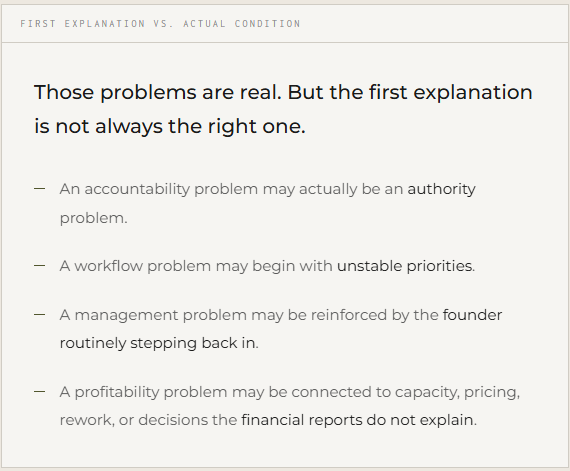
Until the business understands what is actually creating the drag, it is easy to spend money solving the wrong problem.
The Operating Standard Assessment is designed to separate the visible symptoms from the operating conditions producing them.
This is not a self-assessment quiz.
The founder completes an intake. The company undergoes an assessment.
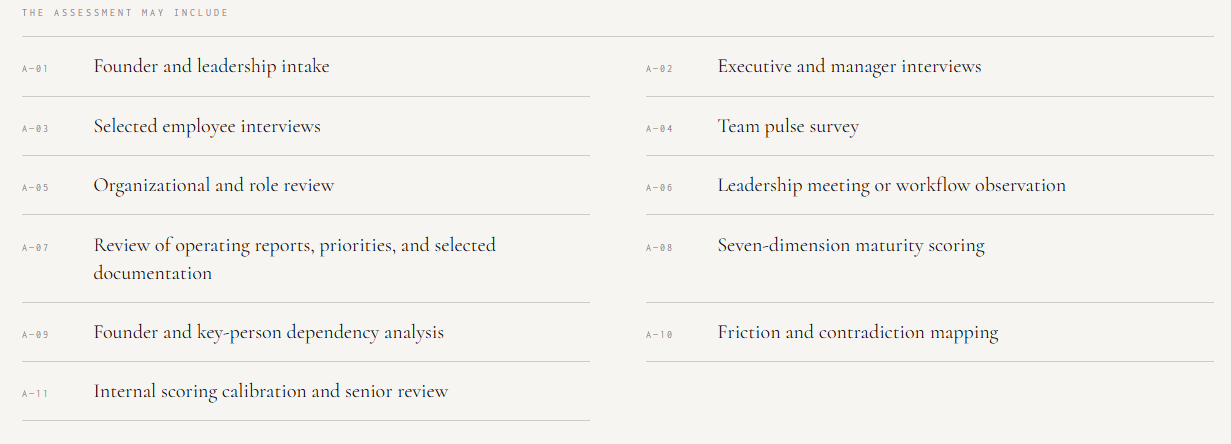
We combine leadership perspective with stakeholder input, documents, operating patterns, and business outcomes to understand the difference between how the company is designed to operate and how it actually operates.
We do not assume that the owner’s explanation is wrong.
We also do not assume it is the whole story.
You leave with more than a score.
The purpose of the assessment is not to label the business as healthy or unhealthy. It is to determine what the company can reliably carry today, what remains vulnerable, and what must be built before it can carry more.
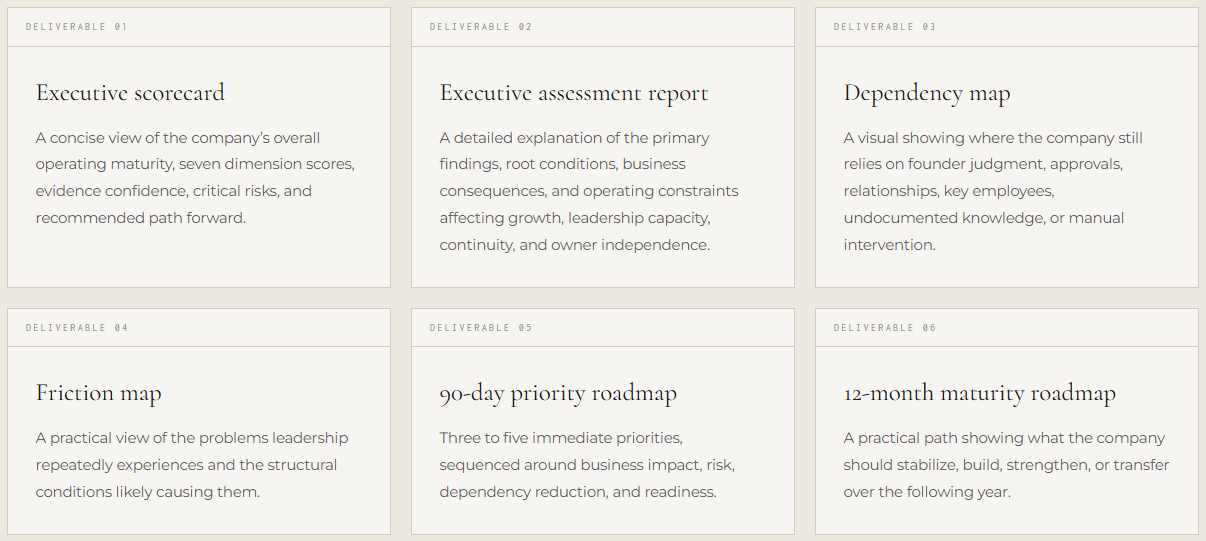
No generic advice. No bloated list of recommendations. No software prescription before we understand the business.

The report is not emailed into the void.
WE WALK THROUGH: 01: What the business can currently carry
02: What is actually running the company
03: Where the founder or key employees are supplying hidden capability
04: The most important contradictions
05: The three to five primary operating constraints
06: The business consequences of leaving them unresolved
07: What should happen first
The final report is delivered after the findings session, followed by a leadership debrief to confirm priorities, ownership, and the appropriate next step.
The goal is not simply to understand the findings. It is to make them usable.
Built for businesses that have outgrown informal management.
The Operating Standard Assessment is designed for established founder-led companies that have enough success, people, and complexity for the current way of operating to have become a constraint.
THIS WORK IS ESPECIALLY VALUABLE WHEN:
Too many decisions still depend on the owner
Managers carry responsibility without enough authority
Leadership is unsure whether the problem is people, process, structure, or management
The owner wants the business to become less dependent on personal involvement
The company has a growing team or management layer
The same accountability or execution issues continue to resurface
Growth is adding more complexity than capacity
The company is preparing to expand, transition, acquire, or eventually sell
You do not need to be in crisis.
You do need to be willing to look honestly at how the company operates, including the role leadership may be playing in the current constraints.
Find out what the business can carry and what needs to change first.
The assessment begins with a fit conversation. We review where the business is, what leadership is experiencing, and whether a full assessment is the right next step.